What To Eat In Rome: The Dishes That Define The City
Four pastas built on guanciale and pecorino, a Jewish artichoke, a slaughterhouse quarter's offal cooking, and street food sold by weight: Rome's food identity is narrower and deeper than almost any city in Italy, and every dish in the canon has a specific room where it is cooked well and a specific way of getting a table there.
Short answer
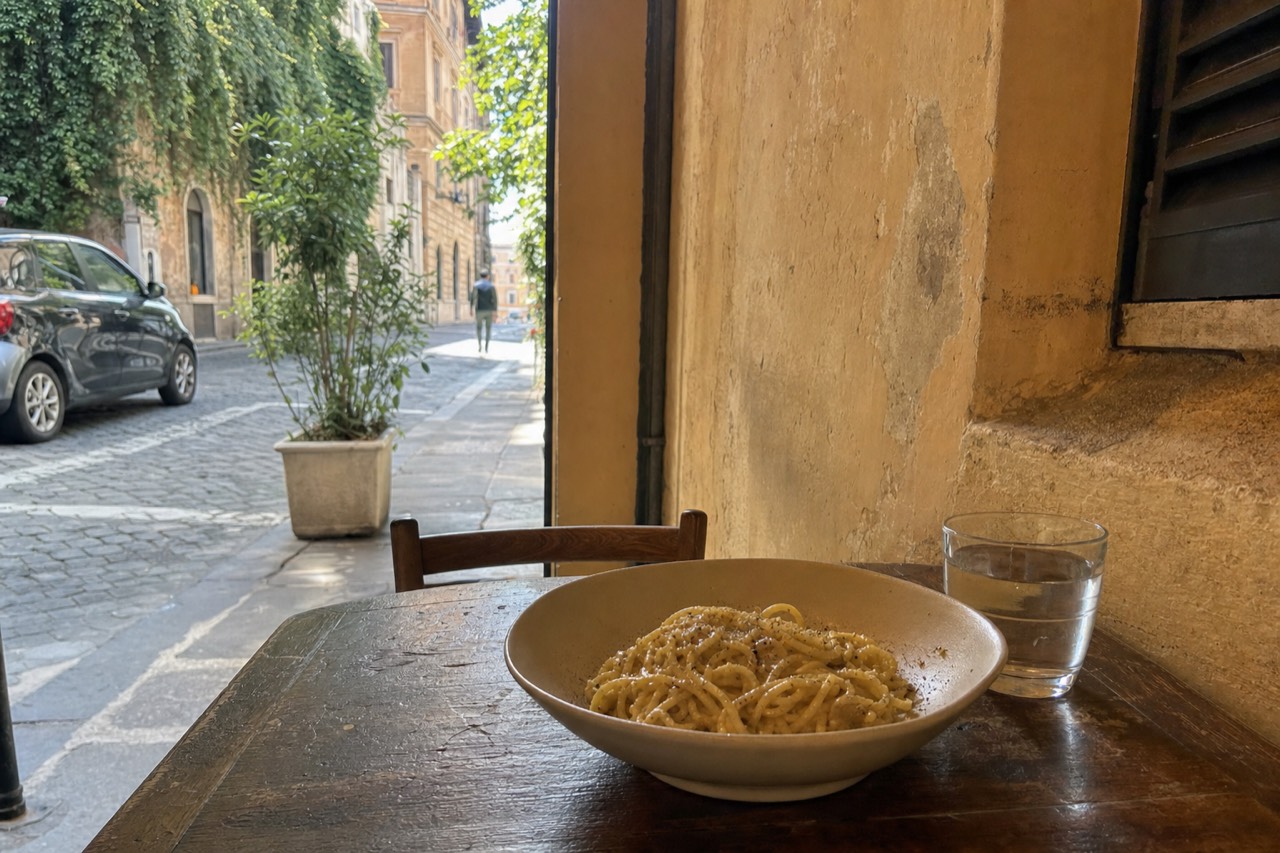
Rome's most famous dishes are four pasta sauces: carbonara, cacio e pepe, amatriciana and gricia, all built on guanciale and Pecorino Romano. Around them sit carciofi alla giudia from the Jewish Ghetto, quinto quarto offal cooking from Testaccio, and pizza al taglio sold by weight. Carbonara is generally named the most popular pasta dish in the city.
Rome's cooking is a canon, not a catalogue. Ask what to eat here and the honest answer is short: four pasta sauces built on the same two ingredients, a fried artichoke from the Jewish Ghetto, the offal cooking that grew out of a slaughterhouse, and street food sold by weight at a counter. The interesting part is not the list, which every guide carries, but what sits underneath it: why pecorino rather than parmigiano, why guanciale rather than pancetta, which rooms cook each dish well, and what it takes to get a table in them. This page takes the dishes in order and gives each one a place, an opening position and a booking position.
What Food Is Rome Famous For?
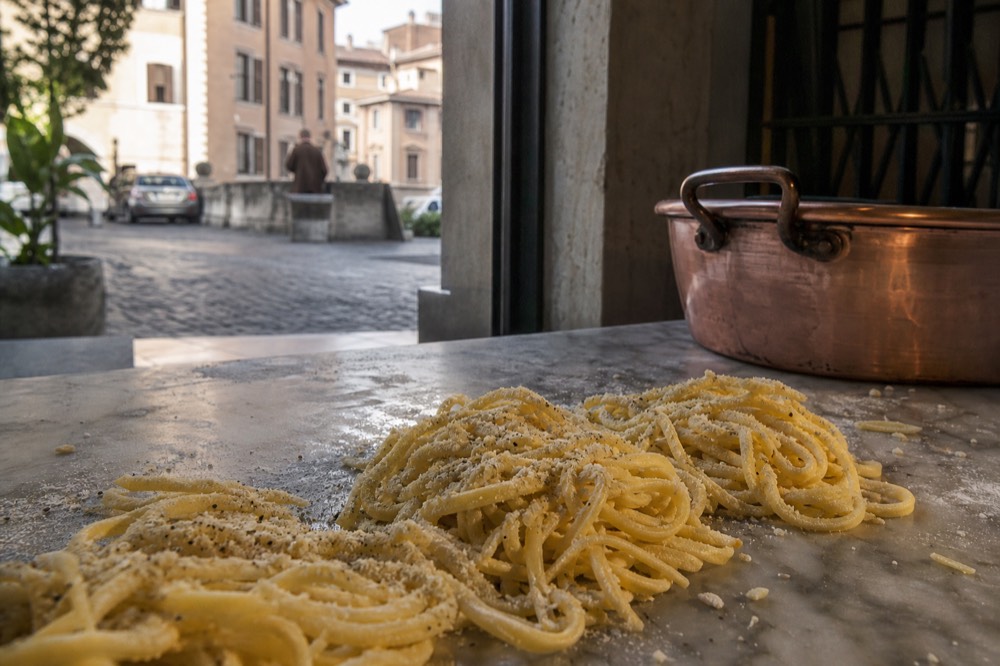
Rome is famous for a tight canon of pasta sauces built on guanciale and Pecorino Romano: carbonara, cacio e pepe, amatriciana and gricia. Around them sit carciofi alla giudia from the Jewish Ghetto, the quinto quarto offal cooking of Testaccio, and street food, pizza al taglio, supplì and trapizzino, sold at counters rather than tables. The city's cooking is a cucina povera tradition of a few ingredients done precisely, not a wide repertoire.
That narrowness is the point. The four pastas share a spine: cured pork jowl or sheep's-milk cheese, black pepper, and pasta water used as a technical tool rather than an afterthought. Amatriciana is the only one with tomato, and gricia is amatriciana before the tomato arrived, which is why Italian sources call it "amatriciana bianca". Every other Roman classic, the fried artichoke, the tripe, the oxtail stew, comes from a specific quarter with its own history rather than from a shared national repertoire.
Two ingredients decide whether a Roman dish is Roman. Guanciale is cured pork jowl or cheek, higher in fat and firmer than pancetta, which comes from the belly. Pecorino Romano is a sheep's-milk cheese; Parmigiano-Reggiano is made from cow's milk, and Italian sources treat even a partial substitution in carbonara as a recent departure rather than a tradition. A menu that advertises carbonara with cream, pancetta or both is telling you what it is.
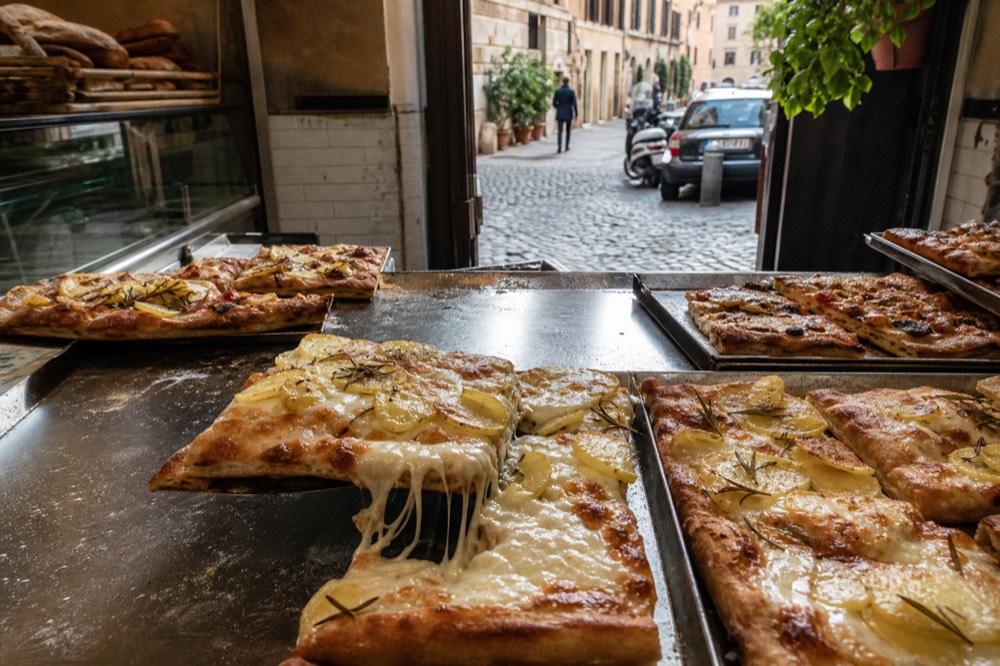
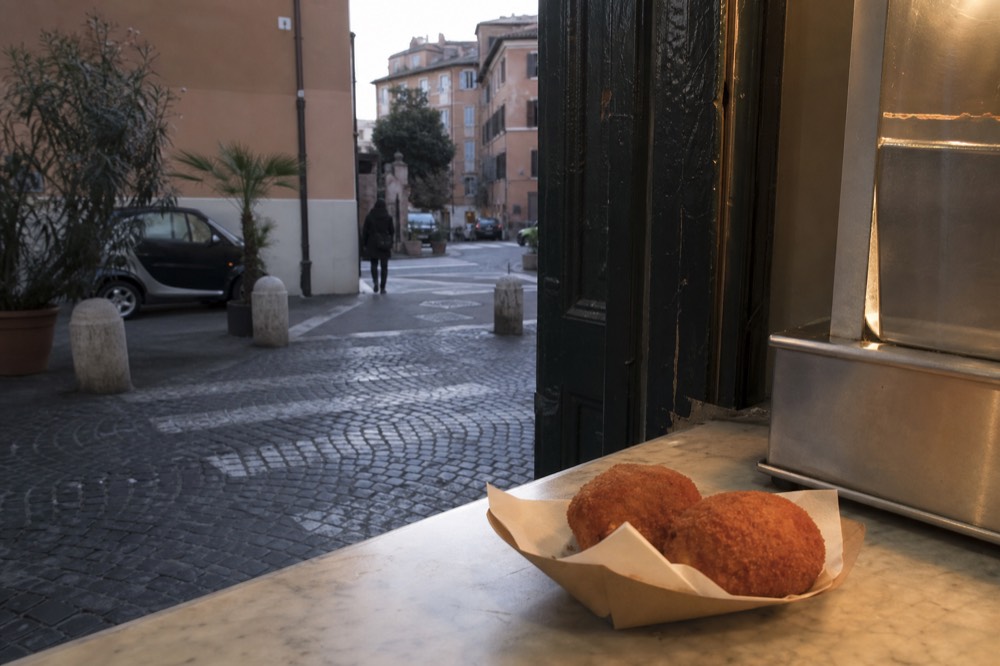
The street-food half of the fame is cheaper and easier. Pizza al taglio is sold by weight, quoted per kilo, so you point at a tray, the counter cuts the piece you want and weighs it, and the price follows. Supplì are fried rice croquettes with a molten mozzarella centre, the cheese pull that gives the classic version its name, supplì al telefono. Where to find the good counters is covered in our Rome street food guide.
What Is The Most Popular Pasta Dish In Rome?
Carbonara is the most popular pasta dish in Rome and the one most often named the city's signature. Its traditional form is five ingredients only: pasta, guanciale, pecorino romano, egg yolk or egg, and black pepper. No cream, no garlic, no onion, no pancetta. It is the dish Roman trattorias are judged on and the one most frequently made badly, because the emulsion of egg, cheese and pasta water fails more easily than it succeeds.
The recipe is not a matter of taste. La Cucina Italiana gives the traditional version as exactly five ingredients, and the registered amatriciana specification from the EU Official Journal, while governing a different sauce, sets the pattern for the whole canon by excluding garlic, onion and pork belly outright. Carbonara's failures are almost always substitutions: cream where the egg should do the work, pancetta where guanciale's firmer, fattier jowl should render into the sauce.
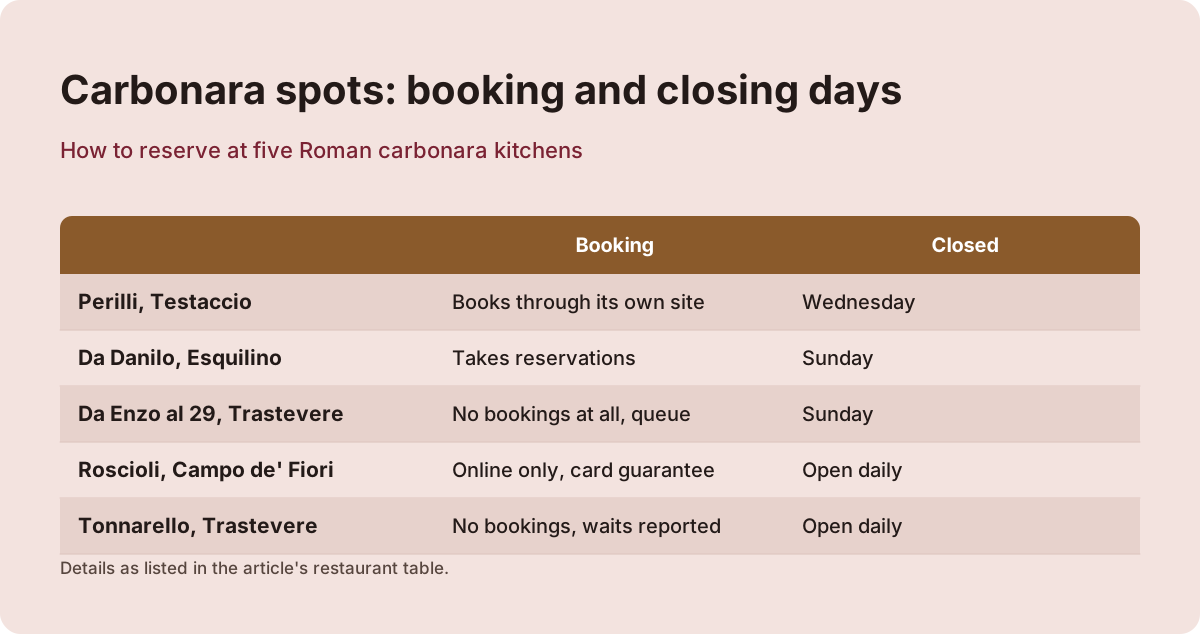
Where it is cooked well: Perilli, a Testaccio room trading since 1911, serves carbonara alongside amatriciana and gricia and takes reservations through its own site, closed Wednesdays. Da Danilo in Esquilino does a carbonara finished theatrically in a wheel of pecorino, takes reservations, and closes Sundays. Da Enzo al 29, the most-recommended trattoria in Trastevere, is the room people cross the city for, and its own site says plainly, "Non si accettano prenotazioni": no reservations, in any service. A dated review describes a line out the door, so the price of the plate is your evening's first half hour.
For cooking it yourself, the pasta class with wine, dessert and limoncello near the Pantheon runs from $68.52 per person (checked September 2026), about three hours, rated 4.9 across 3,493 reviews on the operator's live listing.
The class covers the other route into the canon: making the emulsion work with your own hands. Roscioli Salumeria con Cucina, near Campo de' Fiori, is the other name always attached to carbonara, and its booking page is strict: online only, a credit card held as guarantee, and the booking exists only once the confirmation email arrives.
| Where | Dish | Booking position | Closed |
|---|---|---|---|
| Perilli, Testaccio | Carbonara, gricia, amatriciana | Books through its own site | Wednesday |
| Da Danilo, Esquilino | Carbonara in a pecorino wheel | Takes reservations | Sunday |
| Da Enzo al 29, Trastevere | Rigatoni alla carbonara | No bookings at all, queue | Sunday |
| Roscioli, Campo de' Fiori | Carbonara at a salumeria table | Online only, card guarantee | Open daily |
| Tonnarello, Trastevere | All four sauces on tonnarelli | No bookings, waits reported | Open daily |
What Are The Four Most Famous Pastas In Rome?
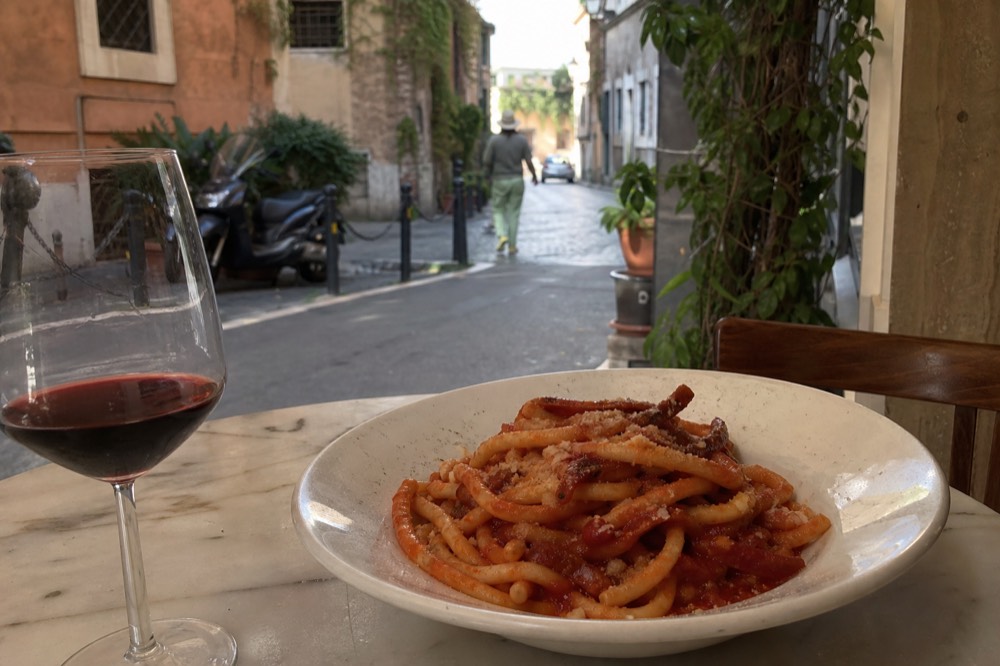
The four most famous pastas in Rome are carbonara, cacio e pepe, amatriciana and gricia. Carbonara adds egg to guanciale and pecorino; cacio e pepe drops the pork entirely and is only pecorino, black pepper and pasta water; amatriciana adds tomato to guanciale and pecorino; gricia is that combination without the tomato, the "white amatriciana". Each is a registered or documented tradition, and together they are the exam a Roman kitchen sits.
Gricia is the one visitors order least and Romans respect most. Guanciale, pecorino romano and black pepper, with the fat from the jowl doing everything the tomato does in its red sibling. Italian sources describe it as the tomato-free ancestor of amatriciana, and its survival on menus is a fair signal that the kitchen is cooking the canon rather than editing it for tourists.
Cacio e pepe looks like the simplest of the four and is the hardest. Pecorino romano, black pepper, pasta water: nothing else, and no fat to hide behind. A 2025 paper in Physics of Fluids studied the sauce and named the failure mode: below one per cent starch relative to the cheese mass, the mixture forms system-wide clumps, a condition the authors call the Mozzarella Phase. That is the science behind the clotted plate every visitor has met once. Da Felice a Testaccio is famous for tossing it at the table; it books online, refuses cancellations by phone or email, and a dated guide advises booking three weeks ahead, though the restaurant itself publishes no window. Flavio al Velavevodetto, dug into the Monte dei Cocci in Testaccio, books online or by telephone.
Amatriciana carries the strongest paperwork of any dish on this page. It is a registered Traditional Speciality Guaranteed under EU regulation, with a specification that fixes guanciale at 18 to 30 per cent of the finished product and excludes garlic, onion and pork belly by name. Checchino dal 1887 in Testaccio, Piatto Romano and Trattoria Da Teo all cook it inside the traditional frame.
| Pasta | Core ingredients | What it adds to the others |
|---|---|---|
| Gricia | Guanciale, pecorino, pepper | The base: no tomato, no egg |
| Amatriciana | Guanciale, pecorino, tomato | Tomato on the gricia base |
| Carbonara | Guanciale, pecorino, egg, pepper | Egg replaces the tomato |
| Cacio e pepe | Pecorino, pepper, pasta water | No pork at all |
The canon is compact enough that a single evening can cover it badly or a single week can cover it properly. A tour removes the reservation problem: the Testaccio market walk with three Roman pastas includes nine tastings among the market stalls, runs from $128.83 per person (checked September 2026), about three and a half hours, rated 4.9 across 1,760 reviews, meeting at Piazza Testaccio 39.
The three formats above answer the canon from three angles: a market-based tasting walk in the quarter where much of it was born, a class where you build the sauce yourself, and a street-food walk that covers the counter half of the tradition. Each carries free cancellation, so nothing here has to be decided finally today.
What Is A Must Eat In Rome?
The must-eat list in Rome beyond the pastas runs: carciofo alla giudia, the deep-fried whole artichoke of the Jewish Ghetto; a supplì eaten standing at a counter; pizza al taglio bought by weight; and coda alla vaccinara, the oxtail stew of Testaccio's slaughterhouse tradition. Each belongs to a specific quarter, and each is eaten in a different setting, from a table booked by telephone to a pavement with a paper wrapper.
The carciofo alla giudia is the one dish on the list that cannot be improvised elsewhere. It is a whole Roman artichoke flattened and fried twice in oil, a Jewish Roman preparation from the Ghetto, where the community has cooked it for centuries. Nonna Betta on via del Portico d'Ottavia books by telephone and closes Tuesdays; Pasticceria Boccione, the kosher bakery two streets away, is the place for the torta di ricotta e visciole, burnt on top, and it is a harder proposition: always a queue, cash only, closed Saturdays, and the tarts sell out, Sundays first.
The street-food half of the list is where Rome is easiest. Pizza al taglio counters post prices per kilo, you point, they cut and weigh, and a 150 to 200 gram slice is a snack rather than a bill. The mechanics are covered in full, with per-kilo figures, in the street food guide; the short version is that a counter selling by weight is telling you it is a neighbourhood business, and a counter selling flat pre-cut slices is telling you it knows its customers want to know the price first.
For the full sweep of the canon in one sitting, the small-group Testaccio tour with fourteen tastings across eight family-run eateries, including a full pasta course, runs from $74.62 per person (checked September 2026), about three and a half hours, rated 4.9 across 293 reviews.
The offal tradition needs a word of introduction rather than a warning. Coda alla vaccinara, trippa alla romana and the rest of the quinto quarto repertoire are the reason Testaccio exists as a food destination, and the rooms that cook them are the oldest on this page. The trapizzino, a pocket of pizza bianca filled with those same stews, is the modern bridge between the tradition and street eating; we cover its history separately in what a trapizzino is.
| Must-eat | Where it comes from | Where to eat it well |
|---|---|---|
| Carciofo alla giudia | Jewish Ghetto | Nonna Betta, books by phone, closed Tuesday |
| Supplì | Citywide counter food | Supplì Roma, walk in, cash only, closed Sunday |
| Pizza al taglio | Citywide by weight | Antico Forno Roscioli, walk in, no booking |
| Coda alla vaccinara | Testaccio quinto quarto | Checchino dal 1887, six hours' notice minimum |
| Torta di ricotta e visciole | Jewish Ghetto bakery | Boccione, queue, cash only, closed Saturday |
What Is Rome's Most Famous Dish?
Carbonara is Rome's most famous single dish, and cacio e pepe is its most imitated abroad. If one plate has to stand for the city it is carbonara: five ingredients, an emulsion that fails visibly when it is wrong, and an origin story that was rewritten in 2026 by a newspaper clipping. Spaghetti alla carbonara was mentioned in a Dutch-language Indonesian paper in August 1939, five years before the American troops usually credited with inventing it arrived in Rome.
That finding, reported by Il Post, came from two Dutch journalists who found the 1939 article and shared it with food historians. It describes two rival trattorias in Trastevere, one of them serving spaghetti alla carbonara as its signature dish. The standard story, that the dish was assembled from American bacon and eggs after 1944, now has an earlier document to answer to, though the historians themselves say "forse": the debate is open, not settled.
Cacio e pepe's claim to fame is different. It has become a global restaurant dish precisely because it looks like nothing, and the physics paper on its failure mode is the unusual case of a pasta sauce getting peer-reviewed attention. Rome remains the place where it is made correctly most often, because the technique is in the water, the cheese and the wrist rather than in a recipe card.
The quinto quarto tradition is the third candidate for the city's signature and the least exportable. Trippa, pajata and coda alla vaccinara were born of a slaughterhouse economy in which the butchers, the vaccinari, were paid partly in the offcuts of the trade, and the neighbourhood's cooking grew around what they brought home. Pajata itself was banned under the BSE-era EU rules around 2001 and re-legalised in March 2015, which makes it the only dish on this page with its own legal history. Checchino dal 1887, the tradition's institutional home, wants at least six hours' notice through its booking form, is closed Mondays and Tuesdays, and publishes its August dates on its own site.
What Are Three Famous Pastas From Rome?
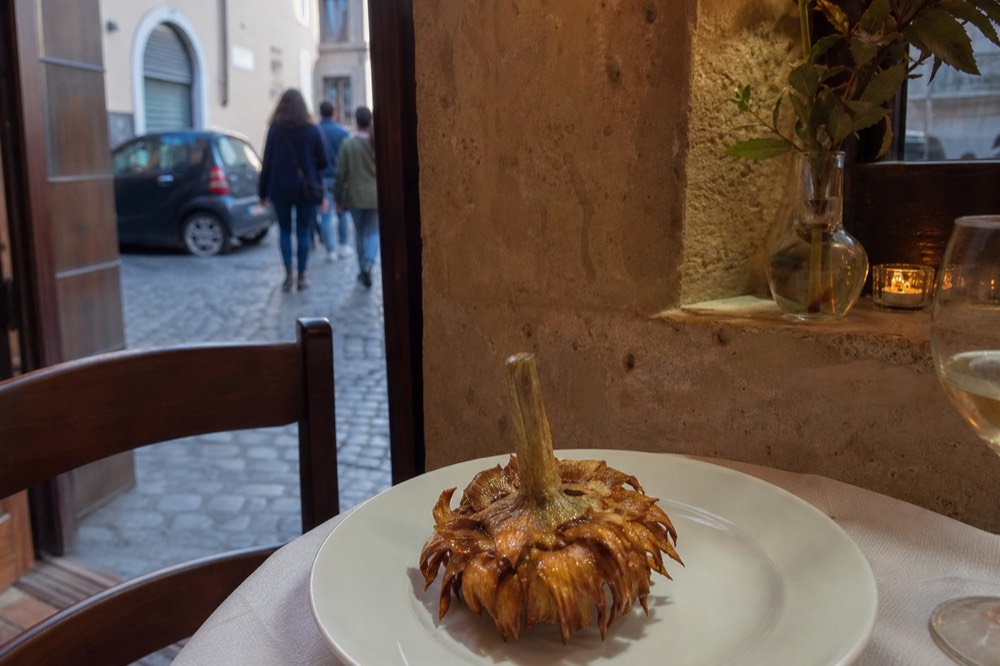
Three famous pastas from Rome are carbonara, amatriciana and cacio e pepe, the trio most named when the question is shortened. Add gricia and you have the full four. All three are cooked across the city in rooms ranging from a no-bookings trattoria with a line out the door to a two-Michelin-star kitchen, and the correct order to eat them in, for a visitor, is whichever room you can actually get into.
The practical answer to "which three" is therefore a booking question. Perilli and Trattoria Da Cesare al Casaletto, out at the end of a tram line in Monteverde, both cook the full canon and both take bookings; Cesare closes Wednesdays. Armando al Pantheon, a family room by the Pantheon since 1961, runs a thirty-day online book that releases a new day at midnight, refuses email bookings outright, and seats no dinner party above six: the queue happens on a website at 00:00 rather than on a pavement at 19:00. Tonnarello, with five rooms in a few Trastevere streets, cooks all four on tonnarelli and takes no bookings at any address, with dated diner reports of waits from forty minutes to over an hour.
A table that cooks one of the three well will usually cook all four, because the techniques overlap: the rendering of guanciale, the emulsion of cheese and starch, the restraint. Choosing by dish is less useful than choosing by friction. Our neighbourhood dining guide maps the rooms by quarter, and the Rome food tours guide covers the tour route into the same canon.
The fresh pasta class with unlimited wine and gelato, from $63.87 per person (checked September 2026) and rated 4.9 across 928 reviews, teaches two shapes and both emulsions in about three hours.
What Is The Classic Roman Pasta Dish?
The classic Roman pasta dish is cacio e pepe: pecorino romano, black pepper and pasta water, the oldest and barest of the canon and the technical root the other three grow from. Gricia is its extension with guanciale, amatriciana adds tomato, carbonara adds egg. Tonnarelli, a thick square-cut spaghetti, is the pasta most associated with it in the city's trattorias, though no single authority fixes a shape for any of the four sauces.
The tonnarelli association matters for one reason: Tonnarello, the trattoria named after the shape, built a five-room business on it. Flavio al Velavevodetto in Testaccio serves its tonnarelli cacio e pepe dug into the Monte dei Cocci, the ancient amphora mound the neighbourhood is built on, and books online or by phone on 06 5744194. Roma Sparita in Trastevere serves its version in a crisp shell of pecorino and books through its own site, though the window is narrow at both ends: at least 24 hours' notice, and no more than 15 days ahead.
The emulsion is the dish. When it fails the cheese clumps and the plate is greasy water; when it holds, the sauce is glossy and lighter than its two ingredients have any right to produce. The 2025 Physics of Fluids paper gave the failure a threshold and a name, the Mozzarella Phase, below one per cent starch relative to cheese mass. That is why Roman cooks reserve pasta water so carefully and why a class that drills the technique, like the fettuccine class at Restaurant Tucci on Piazza Navona, from $59.23 (checked September 2026) for two hours, is a genuinely useful souvenir.
| Classic dish | Technical key | Where it is served classically |
|---|---|---|
| Cacio e pepe | Starch-cheese emulsion | Flavio al Velavevodetto, books online |
| Cacio e pepe in a pecorino shell | The shell adds texture | Roma Sparita, 15-day booking window |
| Tonnarelli, all four sauces | Fresh, thick, square-cut | Tonnarello, no bookings, waits reported |
What Food Is A Must Try In Rome?
The must-try food in Rome, beyond the pasta canon, is the counter food: supplì, pizza al taglio, the trapizzino and the maritozzo. This is the half of the city's eating that needs no booking, no planning and no research beyond knowing which counter to stand at, and it is where the price is fixed by weight or by the piece before you sit, stand or walk.
The supplì is the entry point. A fried rice croquette with a molten mozzarella centre, the classic version with ragù, it costs little and appears at every good counter. The trapizzino is its modern cousin: a triangular pocket of pizza bianca filled with the same Roman stews the Testaccio kitchens serve on plates, and the Testaccio branch is open every day from noon to 23:00, no booking involved. The maritozzo, a split sweet bun filled with whipped cream, is the traditional Roman breakfast and has had a recent revival in savoury versions.
Two mechanics make the counter half cheap and honest. Pizza al taglio is priced per kilo and weighed in front of you, so the size of the piece is your decision. And the city's drinking fountains, the nasoni, run free water: ACEA, the water utility, counts over 3,000 drinking fountains across Rome, more than 200 of them in the historic centre, so a bottle refilled at one is the standard accompaniment. The budget mechanics are laid out in eating in Rome on a budget.
The two-quarter street food walk, covering Trastevere and Campo de' Fiori in 2.5 hours with tastings of pizza, supplì, gelato and sandwiches, is the cheapest structured way into this half of the canon, from $48.37 per person (checked September 2026), rated 4.9 across 4,191 reviews, meeting at the fountain in Piazza San Simeone.
What Is The Most Popular Roman Dish?
By orders placed and by tables that queue, the most popular Roman dish is carbonara, followed by cacio e pepe and amatriciana; by fame carried abroad, carbonara again, in versions that would not be recognised in the city. Carbonara Day, 6 April, has been celebrated annually since 2017 and marked its tenth edition in 2026, which is a fair measure of how far the dish has travelled beyond the canon it belongs to.
Popularity has a cost, and in Rome the cost is measured in friction. The rooms most famous for the popular dishes are the ones with the hardest mechanisms: Da Enzo al 29 takes no bookings at all; Armando al Pantheon releases its book at midnight thirty days out; Roscioli wants a card as guarantee and a confirmation email before the table exists. The dishes are popular enough that the city has built systems to ration them.
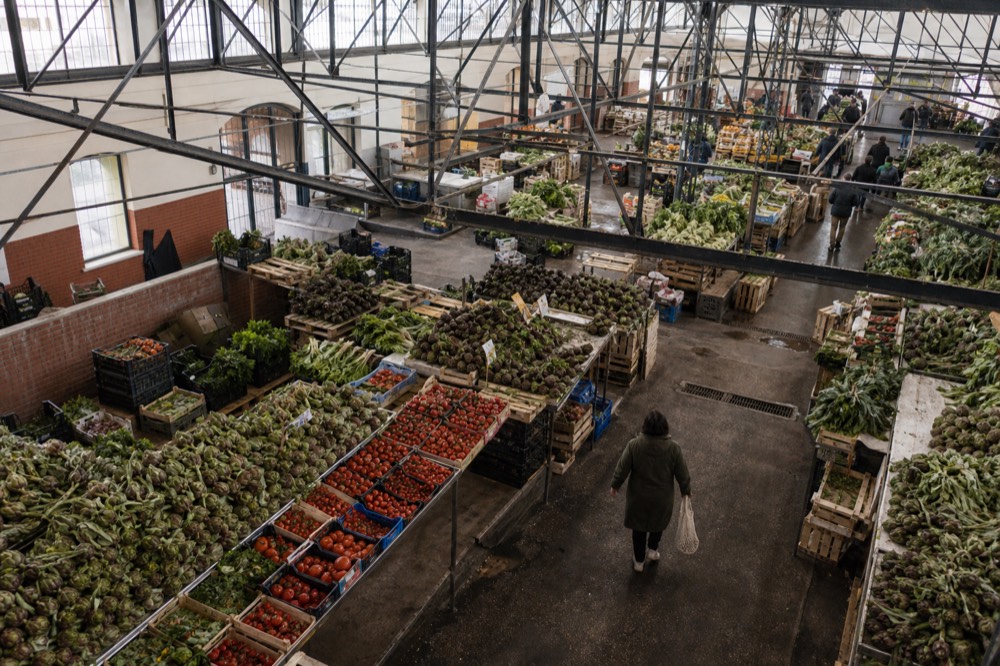
The counterweight is the street. The same canon's cheaper relations, the supplì, the pizza al taglio, the trapizzino, arrive with no mechanism at all, and the markets that house them are walk-in by definition. The Nuovo Mercato Testaccio, where Mordi e Vai's boiled-beef sandwiches and CasaManco's pizza alla pala trade, is open Monday to Saturday 07:00-15:30 and closed Sunday, so it is a breakfast and lunch destination only. The market's official site is the source for those hours, and it is the one to check before you plan a morning around it.
The twilight Trastevere walk, six to seven curated tastings with local wines poured along the way, about four hours from $123.12 per person (checked September 2026) and rated 4.9 across 6,343 reviews, is the evening version of the same idea, meeting on the Tiber Island.
Where Does The Offal Tradition Fit In?
Testaccio's quinto quarto tradition, the cooking of the slaughterhouse offcuts, is the historical root of Roman cuisine's cucina povera, and the reason the quarter, not the centre, is where food writers eat. The Mattatoio, Rome's municipal slaughterhouse, closed in 1975, but the dishes it left, coda alla vaccinara, trippa alla romana and rigatoni con la pajata, still anchor the menus of the quarter's oldest rooms, and the market next door still feeds the neighbourhood.
The mechanism of the tradition is documented: the vaccinari, the slaughterhouse butchers, were paid partly in cash and partly in the offcuts of the trade, and the quarter's cooking grew around what they carried home. The rest of the origin story, the folk version about the pig being divided among four social classes, is exactly that, a story, and no reliable source backs it as fact. What is printable is the cooking itself and the rooms that still do it.
Checchino dal 1887 is the institution: a booking form that wants at least six hours' notice, closed Mondays and Tuesdays, and dark from 3 to 21 August by its own site. Piatto Romano books online and publishes its own closure, 9 August to the lunch service of 7 September. Da Teo, across the square, serves coda alla vaccinara alongside the pastas, is closed Sundays, and announced its own summer closure on Instagram. Santo Palato, the modern room that brought the repertoire back, holds Gambero Rosso Tre Gamberi and books online.
The quarter is also the easiest place to eat the canon without a plan, because the market and the counters absorb the overflow. Volpetti, the salumeria, is a shop counter with a Sunday closure and nothing to book. Mordi e Vai is a market box with a queue at lunchtime and a market clock that stops at 15:30. This is the one quarter where the hardest booking and the easiest walk-in sit five minutes apart.
| Testaccio venue | What it cooks | Booking position | Closed |
|---|---|---|---|
| Checchino dal 1887 | Quinto quarto canon | Form, six hours' notice | Monday, Tuesday |
| Piatto Romano | Roman classics, offal | Books online | Sunday |
| Da Felice a Testaccio | Cacio e pepe tossed at table | Online only, no phone cancellation | Open daily |
| Flavio al Velavevodetto | Tonnarelli cacio e pepe | Online or telephone | Varies |
| Mordi e Vai | Boiled-beef sandwiches | Walk in, lunch only | Sunday, with market |
| Volpetti | Cheeses and cured meats | Walk in | Sunday |
How Do You Turn The Canon Into A Plan?
Turn the canon into a plan by matching dish to friction: book the trattorias weeks or days ahead, walk into the counters and markets at any hour, and use a tour or a class for the evening you cannot be bothered to plan. Carbonara, cacio e pepe, amatriciana and gricia live mostly in rooms that book; the carciofo, the supplì, the pizza al taglio and the trapizzino live in counters that never have.
Start with the bookings that matter most. Armando al Pantheon's book opens at midnight, thirty days out; Roscioli wants a card and a confirmation email; Da Felice is online only and will not cancel by phone. Fill the days around them with the walk-in half: the Ghetto for the artichoke and the torta, the markets for the counters, the gelaterie, which never take a booking in their lives, for the evening. The balance is what the Best Restaurants in Rome site is built around: the hard half of the city is real, and the easy half is just as real.
Respect the calendar. Many of the rooms named on this page close one day a week, each on its own schedule: Checchino Monday and Tuesday, Perilli Wednesday, Nonna Betta Tuesday, Boccione Saturday for Shabbat. August is its own problem, and the only city-level figure worth quoting is Il Messaggero's, reported from the trade associations: about 40 per cent of shops and restaurants close for two weeks or more, most of them away around 15 to 18 August. The rest take short breaks or stay open; Roscioli, for instance, is open through August except the 15th itself.
For the hours you would rather not spend planning, the same canon exists in tour and class form, fixed in price before you go. The trio below is the spread: the Testaccio market walk, the pasta class near the Pantheon and the two-quarter street food walk.
| Day of the week | Easiest plan | Needs booking |
|---|---|---|
| Monday | Testaccio market, Volpetti, gelaterie | Checchino closed |
| Tuesday | Counters and market again | Nonna Betta closed |
| Wednesday | Trastevere counters, La Renella | Perilli, Cesare closed |
| Saturday | Ghetto bakery early, then Trastevere | Boccione closed |
| Sunday | Mercato Centrale, Eataly, Tonnarello | Da Enzo, Da Teo, Da Remo closed |
What Food Dish Is Rome Famous For?
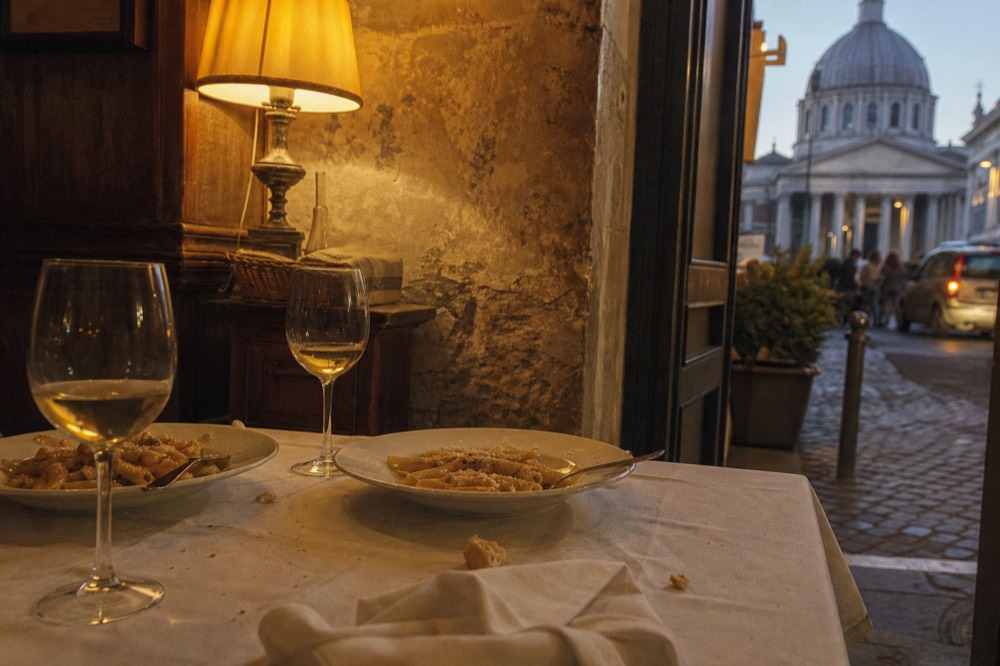
If the question means a single dish, Rome is famous for carbonara, whose five-ingredient traditional recipe and contested origin have made it the city's ambassador plate. If it means a dish you cannot get elsewhere, it is the carciofo alla giudia of the Jewish Ghetto, a deep-fried whole artichoke tied to a community and a quarter rather than to a recipe that travels. Between those two sit cacio e pepe, amatriciana, gricia, and the offal cooking of Testaccio.
The carbonara origin question is worth knowing because it changed in 2026. The standard account ties the dish to American troops and their rations after 1944; the newly surfaced 1939 clipping, in a Dutch-language Indonesian newspaper, describes a Trastevere trattoria serving it before any of that. Italian food historians treat the older attestation as significant but not as a settled answer, and the honest position is that the dish is older than the story and neither story is finished.
The carciofo is the less argumentative answer. It belongs to the Jewish Roman community, the oldest continuous Jewish population in Europe, and to the few square blocks where it is fried properly. Nonna Betta books by telephone, 06 68806263, and closes Tuesdays. It is the one item on this page that a visitor cannot approximate at home, which is the real definition of famous-for-one-place.
The traditional carbonara recipe, five ingredients and no cream, is published by La Cucina Italiana; it is the version against which the city's trattorias, and the imitations abroad, are measured.
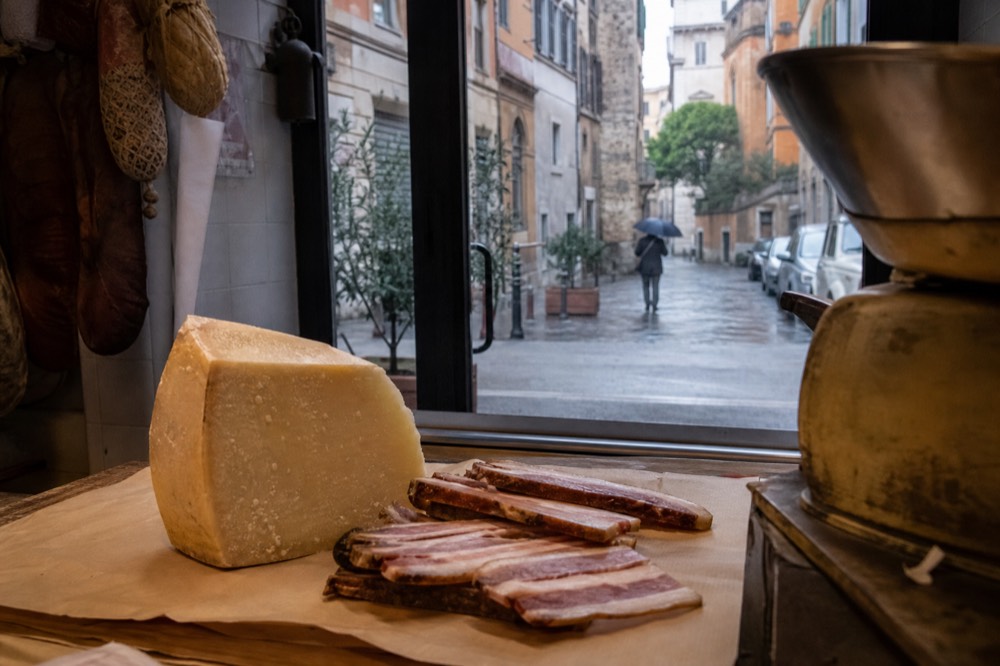
The short answers: four pastas built on guanciale and pecorino, a fried artichoke from the Ghetto, the offal cooking of Testaccio, and counter food sold by weight. The questions below cover the same ground in the forms people actually search it, each with the specific rooms and booking positions named above.
Common Questions About What To Eat In Rome
What Is A Must Eat In Rome?
The four pasta sauces, carbonara, cacio e pepe, amatriciana and gricia; the carciofo alla giudia from the Jewish Ghetto; a supplì from a counter; pizza al taglio bought by weight; and, if you reach Testaccio, the quinto quarto offal cooking. That list, eaten across a week of booked tables and walk-in counters, is the city.
What Is The Must-Eat Food In Rome?
Carbonara made with guanciale, pecorino and egg, no cream, is the single must-eat. Perilli, Da Danilo and Roscioli all cook it inside the traditional frame, and each takes a different kind of booking.
What Food Is Rome Famous For?
A tight canon of pasta sauces built on guanciale and Pecorino Romano, Jewish Roman fried artichokes, the offal cooking of Testaccio's slaughterhouse quarter, and street food sold by weight: pizza al taglio, supplì and the trapizzino.
What Food Dish Is Rome Famous For?
Carbonara as the ambassador dish, and the carciofo alla giudia as the one plate that cannot be had properly anywhere else. Both are tied to specific quarters and specific rooms.
What Is Rome's Most Famous Dish?
Carbonara. Its traditional recipe is five ingredients, its origin story was rewritten by a 1939 newspaper mention surfaced in 2026, and Carbonara Day, 6 April, marked its tenth edition in 2026.
What Is The Most Popular Pasta Dish In Rome?
Carbonara, ordered more than any other pasta in the city's trattorias and imitated more than any other Italian pasta abroad.
What Are Three Famous Pastas From Rome?
Carbonara, amatriciana and cacio e pepe. Add gricia, the tomato-free ancestor of amatriciana, and you have the full canon of four.
What Are The Four Most Famous Pastas In Rome?
Carbonara, cacio e pepe, amatriciana and gricia. They share guanciale, pecorino and pepper, and each differs from the gricia base by one element: tomato, egg, or nothing at all.
What Is The Classic Roman Pasta Dish?
Cacio e pepe, the barest of the four: pecorino romano, black pepper and pasta water, with tonnarelli the shape most associated with it in the city's trattorias.
What Is The Most Popular Roman Dish?
Carbonara by volume, with cacio e pepe and amatriciana behind it. The popularity is why the rooms that cook them best have the hardest booking mechanisms.
What Food Is A Must Try In Rome?
The counter food: a supplì al telefono, a weighed slice of pizza al taglio, a trapizzino filled with a Roman stew, and a maritozzo con panna for breakfast. None of them requires a booking.