What Time Do Romans Eat Dinner?
Roman kitchens open between 18:00 and 20:00 and locals sit down later: the sourced service times, the second sitting, and how timing changes your walk-in odds in Rome.
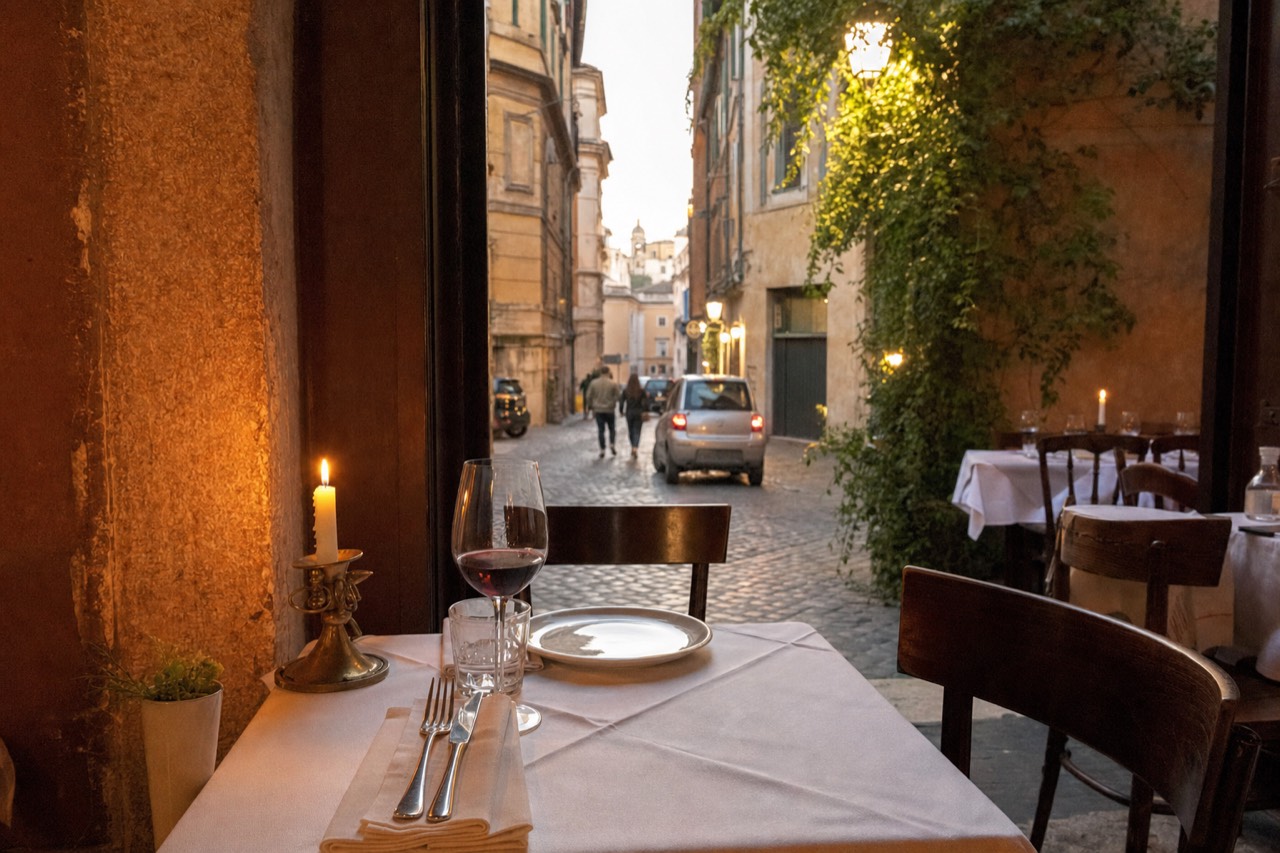
A Roman kitchen does not open for dinner when a Roman sits down for dinner. The city's restaurants start serving the evening menu from roughly 18:00 at the earliest, with most kitchens firing from 19:00 to 19:30, while the local trade files in from about 20:00 onward. Turn up at half past six and you will be eating, but you will be eating in a room of other people who also turned up at half past six. That gap between the service start and the local arrival is the mechanism behind an entire genre of bad meal reviews: not bad food, just a room with nobody in it.
The honest answer needs two clocks, one for the kitchen and one for the diner. Rome's own restaurants publish the first clock on their sites, so the service times below are their own numbers, not a folk figure. The second clock is reported, not legislated: diners and the Italian press describe Romans sitting down from around 20:00, and kitchens that stay open late into the night exist precisely to catch that crowd. Both halves matter, because a table that is easy at 18:30 can have a line out the door by 21:00.
The difference is not snobbery, it is logistics. A trattoria that cooks to order in a small room turns its tables once, maybe twice, an evening. The first sitting belongs to whoever arrives when the door unlocks, and in the centre that is overwhelmingly visitors. The second sitting, from around 20:00, is when the neighbourhood eats, and it is also when the walk-in math gets hard. Plan around the second sitting and you plan around the city as it actually runs.
For an evening built around this rhythm, the three formats below each solve a different part of it: a twilight walk timed to the local hours, a long tasting dinner that fills the whole evening, and a short late tasting for the end of the night.
The Twilight Walk, Wines Included is the clearest fit for the timing question itself: it runs about four hours from Piazza S. Bartolomeo All'Isola, from $123.12 per person (checked September 2026), rated 4.9 across 6,343 reviews, with six to seven curated tastings through Trastevere and local wines poured along the way. It starts the evening inside the window when the neighbourhood is filling up, which is the exact window this page is about.
When Do Roman Kitchens Actually Open?
The earliest dinner start among Rome's well-known trattorias is 18:00, at Armando al Pantheon, which serves Monday to Friday until 23:00; Da Enzo al 29 opens at 18:30, Sora Lella starts dinner at 19:20, and La Carbonara in Monti begins at 19:00. The service window runs to about 22:30 or 23:00, so a 21:00 arrival is normal and a 22:00 arrival is pushing the kitchen.
These are opening times published by the restaurants themselves, which is the only kind worth printing. Armando al Pantheon posts lunch from 12:30 to 15:00 and dinner from 18:00 to 23:00, Monday to Friday, with a closure from Saturday evening and all day Sunday. Da Enzo al 29 serves 12:00 to 15:00 and 18:30 to 22:30, Monday to Saturday, on its own site. Sora Lella, on the Tiber island, gives dinner from 19:20 to 22:50. L'Arcangelo in Prati runs a summer dinner service from 19:00 to 22:30. Tonnarello is the outlier: its Trastevere rooms serve continuously, 11:30 to 23:00, every day.
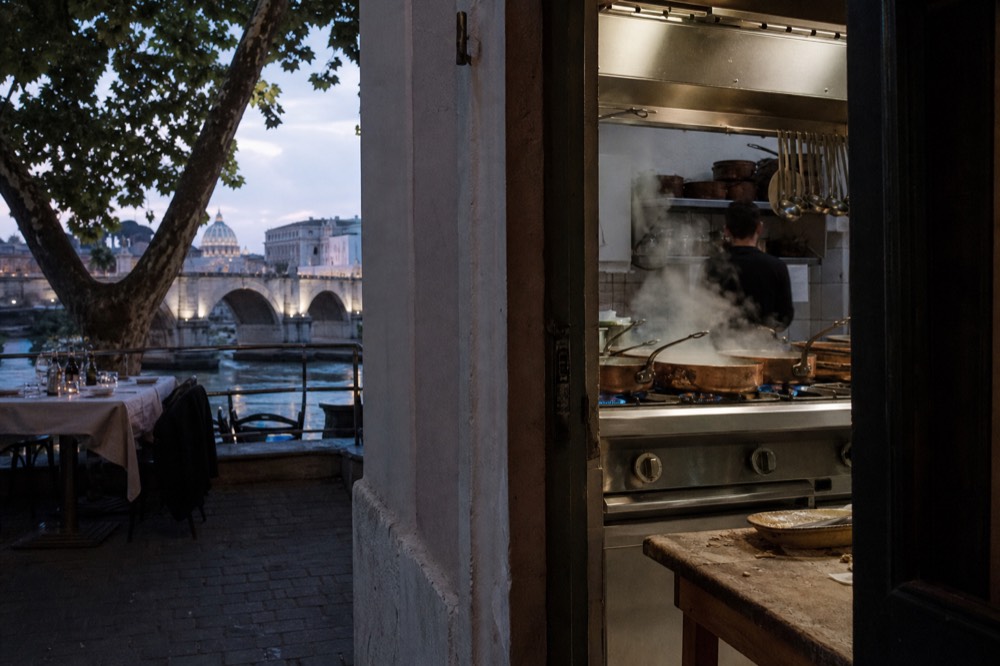
What the table below shows is the spread, not a rule. A family trattoria in Trastevere and a fine-dining room in the centre keep different clocks, and the starred kitchens are dinner-led and closed two days a week besides. The pattern that holds everywhere: the published service starts cluster between 18:00 and 20:00, and none of the best-known Roman tables opens later than 20:00 for dinner.
| Venue | Neighbourhood | Dinner service starts | Dinner service ends | Days closed |
|---|---|---|---|---|
| Armando al Pantheon | Centro Storico | 18:00 | 23:00 | Sunday, Saturday evening |
| Da Enzo al 29 | Trastevere | 18:30 | 22:30 | Sunday |
| Sora Lella | Isola Tiberina | 19:20 | 22:50 | Sunday |
| La Carbonara | Monti | 19:00 | 22:00 | Sunday |
| L'Arcangelo | Prati | 19:00 | 22:30 | Sunday |
| Trattoria Da Teo | Trastevere | dinner service, reservation recommended | evening | Sunday |
| Il Pagliaccio | Centro Storico | dinner-led tasting menus | evening | Sunday and Monday |
One caution: hours and closing days change constantly in Rome, and the restaurants themselves often state only "lunch only", "dinner only" or "closed Sundays" rather than printed clock times, for exactly that reason. The clock times above are the venues' own published figures, and a call or a check of the venue's own page before you go is part of the routine here. That caution is the price of honesty: a page that hands you one guaranteed number is handing you something no source actually guarantees.
If the timing math is starting to look like work, the operator's live listing handles it: the twilight walk is booked like a ticket, with free cancellation available, and the four hours are scheduled against the neighbourhood's real rhythm rather than against your guess at it.
Why Is The Early Room So Different?
A Rome restaurant that is full at 18:30 is full of visitors, because the local trade has not arrived yet, and a centre restaurant serving all afternoon is serving a largely foreign clientele, which the Italian press has reported in the words of the restaurateurs themselves. Arriving early is not wrong, but it is a different meal: an empty room, a kitchen at idle, and staff watching the door.
The "orario continuato" signal is real and sourced. la Repubblica quoted centre restaurants describing customers asking for a plate of pasta at four and five in the afternoon, many of them foreign. The honest reading, and the one the source supports, is about who eats there and when: a kitchen serving all afternoon is serving a mostly visiting trade, and a room that empties between lunch and a 19:00 reopening is running the local rhythm. Report the pattern, not an accusation; plenty of all-day rooms serve perfectly good food to the people who need them.
The empty-room effect does something else that matters for the food itself. Cooking to order in a quiet room is not the same job as cooking to order in a full one, and a trattoria like Da Enzo, a small room of a few tables with plates prepared to order, is built around the rhythm of a service that peaks after 20:00. Arrive at 18:30 and you get the kitchen's warm-up; arrive at 21:00 and you get the kitchen at full speed, but you also get the line that comes with it. There is no hour that gives you both.
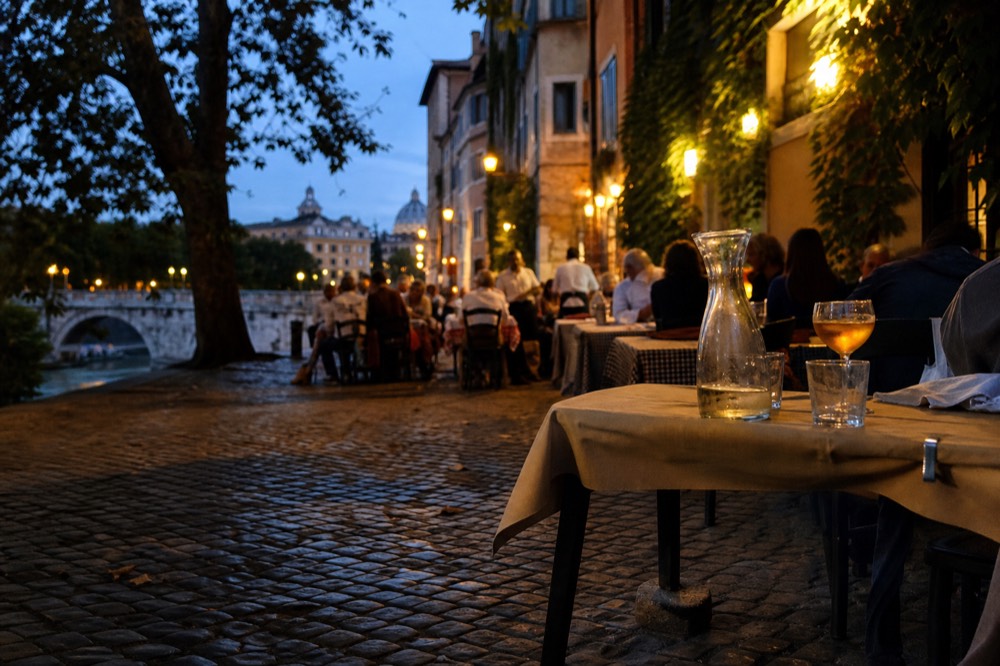
So the practical advice is not "eat late like a Roman" as a slogan. It is: decide what you are buying. The early sitting buys you a guaranteed seat, fast service and a quiet room, at the cost of atmosphere and sometimes of the kitchen's best work. The late sitting buys you the city at its loudest and the food at its peak, at the cost of queues, booked-out rooms and a later night than you may want with children or a dawn start. Both are legitimate; only the mismatch between expectation and hour produces the bad reviews.
The dining rules around the evening carry their own fresh facts, and they interact with timing more than visitors expect:
What Does The Second Sitting Mean For Walk-Ins?
The second sitting, roughly 20:00 to 21:30, is when walk-in odds collapse at the places that take no bookings: Da Enzo al 29 has a line before the door even opens, Tonnarello reports waits from forty minutes to over an hour at peak, and Roscioli's unreserved walk-ins can wait an hour or more on the pavement. Before 19:30, the same doors are dramatically easier.
The arithmetic is brutal and simple. A no-bookings trattoria seats people in arrival order. At 18:30 you are competing with the visitors who planned early; at 20:30 you are competing with the entire neighbourhood plus every visitor who read the same guide. Da Enzo's own site explains the policy in a sentence: a small trattoria with few tables and dishes cooked to order, seating guests in arrival order so nobody is rushed. The consequence is a line, and a dated review describes it as a perpetual line out the door. No sourced duration exists for that queue, so none is printed here.
Tonnarello is the instructive case because it scaled. Five rooms across a few Trastevere streets, all no reservations, all labelled "No Reservation, Just Walk in" on the venue's own site, which also advises avoiding peak hours for the longest waits. Dated diner reports put those waits at forty minutes and at over an hour at peak dinner. The venue's own advice is the honest one: the same kitchen is far easier at 19:00 than at 21:00, and the eleven-and-a-half-hour continuous service means the early edge of the evening is genuinely uncrowded.
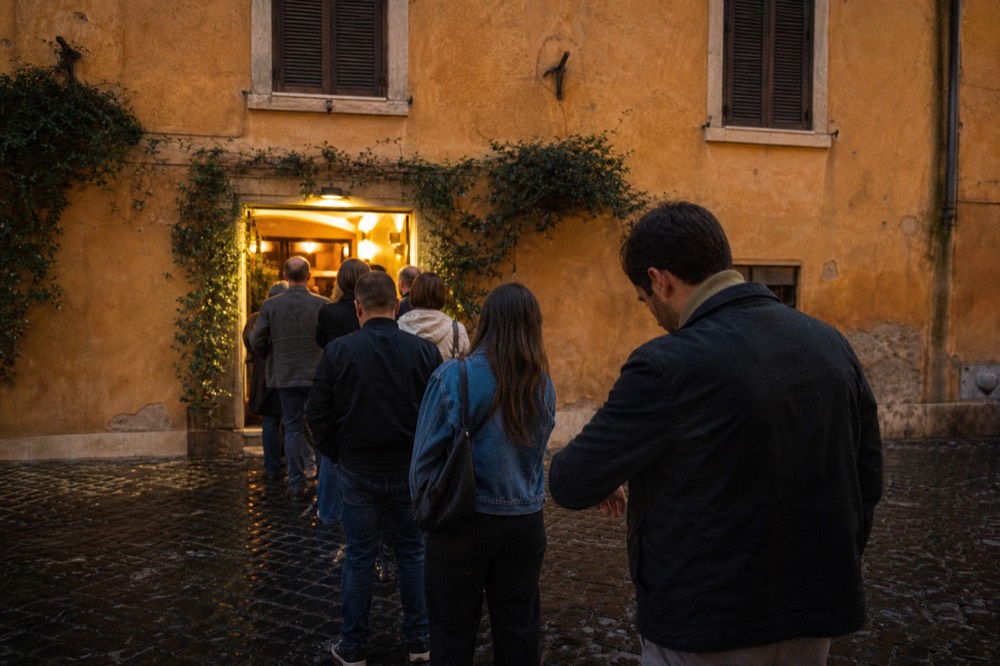
The table below is the page's core planner: your arrival hour against who is in the room against what happens at a no-bookings door. It is a pattern drawn from the venue-published times and the sourced queue reports above, not a promise, and peak nights behave worse than the table.
| Hour of the evening | Who is in the room | Walk-in odds at a no-bookings trattoria |
|---|---|---|
| 18:00 to 18:30 | Almost entirely visitors; staff outnumber diners | Very good; often the easiest seat of the night |
| 18:30 to 19:30 | Visitors plus early local families with children | Good; queues forming at the famous doors |
| 19:30 to 20:30 | The transition; first sitting turning over | Moderate to hard; Tonnarello-class waits begin |
| 20:30 to 21:30 | The local sitting at full volume | Poor; the documented forty-minute to hour-plus waits |
| After 21:30 | Late locals, stragglers, second-shift staff | Improving again, but kitchens close by 22:30 to 23:00 |
There is a second lever besides the hour, and it is the booking mechanic itself. Half the difficulty in this city is concentrated in the specific rooms people have written down, while 29 of the 60 best-known Roman tables and counters take no booking at all and most of those are counters, gelaterie, bakeries and wine bars with friction scores of one or two (see Wine Bars and Frascati). The gelato and coffee stops that close out a Roman evening have no reservation problem and no real queue problem; it is the named trattorias that concentrate the pain. A plan that pairs one hard dinner with easy late stops beats four hard dinners in a row.
One way to buy the whole evening at a fixed price, with the reservation problem removed entirely, is a tasting walk that includes dinner. The 20+ Tastings, Dinner Included format runs about four hours from $120.78 per person (checked September 2026), rated 4.9 across 1,708 reviews, covering more than twenty tastings at four venues with dinner included and free-flowing wine, and pickup is available. Four venues in one booked outing is four reservation problems solved at once, and the timing is set by the operator, not by your luck at a door.
How Do Closing Days Change Dinner Timing?
Closing days cut the dinner map before the clock even starts: of the venues with published closures, Sunday is the heaviest day, with Da Enzo, Roma Sparita, Da Teo, L'Arcangelo, Piatto Romano, Da Remo and Da Danilo all shut, while Checchino closes Monday and Tuesday and Boccione, the kosher bakery, closes Saturday. Per-venue closures are sourced; no sitewide rule exists.
The general claim you will read elsewhere, that Roman trattorias mostly close Monday or mostly close Sunday, does not hold up: no dated source establishes which day is the more common closing day, and one sample contradicted its own conclusion, so it is not printed here. What is printable is the venue's own notice, and there are plenty of them. A Sunday dinner plan in Rome needs to be built from the places that publish a Sunday opening, and a Monday or Tuesday plan needs the same check, because the starred rooms close two days a week: Il Pagliaccio on Sunday and Monday, Marco Martini on Sunday and Monday, La Pergola on Sunday and Monday, dinner only, Tuesday to Saturday.
The interaction with timing is the part people miss. On a Sunday, the rooms that are open are busier earlier, because the closed half of the city's supply pushes everyone into the open half. The same happens in the peak weeks of any season. If your walk-in strategy depends on arriving at 18:45 to an easy door, check the closing-day table first: an easy door on a Tuesday can be a forty-minute door on a Sunday with the identical arrival time.
| Closing pattern | Named venues with published closures | What it does to your dinner plan |
|---|---|---|
| Closed Sunday | Da Enzo al 29, Armando (from Saturday evening), Roma Sparita (Sunday dinner), Da Teo, L'Arcangelo, Piatto Romano, Da Remo, Da Danilo, Pipero | Sunday dinner needs rooms that publish a Sunday service; walk-in rooms that stay open fill earlier |
| Closed Monday and Tuesday | Checchino dal 1887, Il Pagliaccio, Marco Martini | The Testaccio offal canon and the starred rooms vanish from the first half of the week |
| Closed Wednesday | Ai Marmi, Perilli, Da Cesare al Casaletto | Two of the classic pizzeria and trattoria names drop out midweek |
| Closed Saturday | Pasticceria Boccione | Affects the evening's dessert stop in the Ghetto, not dinner itself |
The practical habit that falls out of this: plan dinner by the day of the week first and the hour second. Pick the venue from the list of what is open that day, then pick the sitting that gives you the room you want. Reverse the order and you will optimise your arrival time beautifully for a restaurant that is dark.
Does Dinner Timing Change In August?
August changes both halves of the clock: about 40 per cent of Rome's shops and restaurants close for two weeks or more, most of them away roughly 15 to 18 August, per Il Messaggero's reporting of the trade associations, and the rooms that stay open shift toward the visiting trade, so the early sitting swells and the late sitting thins. Five Rome kitchens publish their own exact shutdown dates.
The scale figure comes with its attribution and keeps it: Il Messaggero reported that only about 40 per cent of shops and restaurants would close for two or more weeks, with the majority taking roughly four days around Ferragosto on 15 August, and this site does not narrow that to restaurants alone or inflate it into "Rome shuts". The named closures are the venue's own: Il Pagliaccio dark from 9 to 27 August 2026, reopening on the 28th; Piatto Romano from 9 August to lunch on 7 September; Checchino from 3 to 21 August; L'Arcangelo from 10 to 31 August; Da Teo from 9 to 30 August. The counterweight, from the same trade round-up: Roscioli stays open through August except the 15th.
Timing inside August inverts the normal logic. The local sitting is thinner because a share of the neighbourhood is at the coast, and the early sitting is fuller because the visitor trade is at its annual peak. That means the walk-in math in mid-August can actually be easier at 20:30 than in June, at the rooms that stay open, while the rooms themselves are fewer and the whole map is smaller. A traveller arriving in the second half of August finds a different city from the one the food guides describe, and the difference is dates, not quality.
The August traveller's routine has three moves. Check the venue's own August dates before committing the evening, because a page that lists no closure may simply not have posted one. Book the rooms that take bookings, since the surviving supply absorbs the demand. And lean on the walk-in half of the city, the counters and markets and gelaterie, which keep short, reliable hours and no reservation mechanic; the Testaccio market trades Monday to Saturday from 07:00 to 15:30, which makes it a lunch institution in August rather than a dinner one, and the late evening falls to the Trastevere rooms and the food halls.
Why Does A Tour Sidestep The Timing Problem?
A booked food tour removes the timing decision entirely: the start hour is set against the neighbourhood's real rhythm, the stops are held for the group, and the price is fixed before you go, which converts the hardest part of a Roman evening, the reservation and the queue, into something you hold a ticket for. It is the same reason a tour never gets you into the famous restaurants: it replaces the booking problem rather than solving it.
That last clause is the honest framing, and this site holds it firmly. No tour listed here enters a famous Roman restaurant, and none claims to. What a tour does is cover ground: several counters in one outing, at an hour chosen by someone who knows when the quarter fills, with free cancellation available on every listing in the roster. For a traveller whose entire risk on a given evening is showing up at the wrong door at the wrong hour, that is the risk removed.
The twilight format is the one built for exactly this question. The Twilight Walk, Wines Included runs about four hours from Piazza S. Bartolomeo All'Isola on the Tiber island, from $123.12 per person (checked September 2026), rated 4.9 across 6,343 reviews, small group, with six to seven curated tastings through Trastevere and local wines poured along the way, and free cancellation available. It begins at the edge of the evening and moves through it, so the timing lesson is embedded in the itinerary rather than explained at you.
For the end of the night, the shortest option on the roster is a 1.5-Hour Speakeasy Tasting: wine and food tasting inside a speakeasy bar in the Monti district, from $34.84 per person (checked September 2026), rated 5 across 15 reviews, with free cancellation available. It fits the slot after a late dinner, or the evening when you want the wine and the atmosphere without committing four hours to it. On the same roster, Best Restaurants in Rome pairs each of these formats with the room-by-room booking mechanics this page has been describing, and the Trastevere dining roundup covers the quarter where most of the twilight walks run. For the full timing picture against the rest of the day, the guide to the aperitivo hour picks up the story at the drink that precedes dinner.
Between the tour formats, the cooked-at-home alternative teaches the same clock from the inside: a pasta class with a market visit turns the late afternoon into preparation and the evening into the meal, which is the Roman structure in miniature. But that is a different article's argument, and the one this page owes you is about hours.
The three formats that book the evening for you, from the twilight walk to the dinner-included tour to the late speakeasy tasting:
The short answers: Roman kitchens open the evening service between 18:00 and 20:00, the local sitting runs from about 20:00 to 21:30, walk-in odds collapse in that window, and August thins the whole map for roughly two weeks around the 15th. The questions below cover the hours people ask about most, from the six o'clock arrival to the late walk-in.
Common Questions About Dinner Times In Rome
What Time Do Romans Eat Dinner?
Roman kitchens open the evening service between 18:00 and 20:00, with most starting around 19:00 to 19:30, and the local trade sits down from about 20:00 onward. There is no single Italian dinner time in the sourced data, so use the range and the per-venue service times rather than one number.
Is 6 PM Too Early For Dinner In Rome?
Only a few kitchens are open that early; Armando al Pantheon starts at 18:00 and Da Enzo al 29 at 18:30. You will be served, but the room will be mostly visitors and quiet, which is a real trade-off rather than a mistake.
Do Rome Restaurants Close In August?
About 40 per cent of Rome's shops and restaurants close for two weeks or more, most away around 15 to 18 August, per Il Messaggero's reporting of the trade associations. Five named kitchens publish their own exact 2026 dates, including Il Pagliaccio from 9 to 27 August and Piatto Romano from 9 August to 7 September, while Roscioli stays open except the 15th.
What Is The Second Sitting At A Roman Trattoria?
The stretch from roughly 20:00 to 21:30 when the local neighbourhood eats. It is the busiest window at no-bookings rooms, where the documented waits run from forty minutes to over an hour at peak, and the quietest window for anyone who chose the first sitting instead.
Can I Walk In Late, After 21:30, In Rome?
Odds improve again after the second sitting clears, but the kitchens close: most dinner services end between 22:30 and 23:00, and Da Enzo al 29 finishes at 22:30. Tonnarello's continuous 11:30 to 23:00 service is the reliable late option in Trastevere, and the speakeasy-style bars run later still.
Is It Rude To Arrive Early For Dinner In Rome?
Not at all, and a table booked for the first sitting is yours. What you are choosing is a quieter room and a kitchen at the start of its service rather than its peak, which suits families with children and anyone with an early morning better than it suits a night out.