Where Does Stanley Tucci Recommend To Eat In Rome?
Which Stanley Tucci Rome food picks are on the record, which are listicle invention, and whether you can actually get a table at the famous trattorie the celebrity lists recycle.
Stanley Tucci has a documented relationship with Rome food on camera, but the gap between what he actually said and what Rome listicles put in his mouth is wide. Search the question and you get the same shortlist of trattorie repeated across page after page, most of them copying each other, none of them citing the scene, episode or interview where the recommendation was made. That matters for planning: a recommendation you cannot source is a guess wearing a famous name.
This page works the other way round. It holds every widely repeated Tucci Rome attribution up against the record, then, for the famous Roman tables that these lists recycle, it reports the thing a traveller actually needs and that celebrity round-ups never include: how each one books, whether it books at all, and what stands between you and a chair. The booking mechanics here are drawn from restaurants' own published policies, not from guides repeating each other. Where a venue is not supported by an on-the-record source, this page says so plainly rather than laundering a listicle claim into an implied endorsement. It is one of the pieces of Rome eating coverage on Best Restaurants in Rome that treats a famous name as a starting point rather than a reservation plan.
Where Does Stanley Tucci Recommend To Eat In Rome?
The documented answer is narrower than the internet suggests: Tucci's on-camera Rome eating is real but limited, and the long lists of trattorie attributed to him around the web are mostly aggregator recycling with no citation behind them. Several of the names those lists repeat are, on the evidence, not Tucci picks at all, just the standard celebrity-Rome shortlist being reshuffled. The honest way to use his taste is as a starting point, not a reservation plan.
The pattern is easy to demonstrate. Pull up five pages answering this exact question and you will find overlapping rosters of famous Roman trattorie, each presented as a Tucci recommendation, and almost never a link to an episode, a clip, an interview transcript or a published quote. What you find instead is the same handful of names circulating between sites, each borrowing authority from the last. That is how a listicle works, and it is why the second half of this page, the booking reality, is worth more to your trip than the first half.
The practical consequence of treating an uncited list as a plan is that you arrive in Rome holding names that are among the hardest tables in the city to get, with no idea of the mechanism required. Rome's most-recommended trattorie are disproportionately the ones that refuse reservations outright or run booking systems with narrow windows and card guarantees. A famous name plus a walk-in-only policy plus a summer trip equals a plan that fails at the door.
The working method for the rest of this page is simple. First, the tables that the celebrity lists recycle, with their current booking mechanics stated from their own published policies. Second, the walk-in half of Rome, the counters and stalls where no booking exists to fail. Third, the tour option, which converts the reservation problem into a fixed-price ticket booked in advance. Each is checked against the venue's own channels, which is more than most listicles can claim.
A food tour earns its place in this conversation for one reason: the roster of Rome food tours on this site visits no famous restaurant, and that is precisely the point. What a tour removes is not the quality of the table but the friction of getting to it, covering several counters in a single booked outing at a price fixed before you travel. Whether that trade is worth it is a separate question from anything a celebrity endorsement answers, and the sections below take it seriously rather than treating the tour as a consolation prize.
Can You Actually Book The Tables The Rome Lists Keep Naming?
Mostly, no, or not the way you expect. Of the famous trattorie that celebrity Rome lists recycle, one refuses reservations in every service, one releases its book at midnight thirty days out, one takes online bookings only against a credit card, and several close one or two days a week plus part of August. The name on the list is the easy half; the mechanism is what decides whether you eat.
Start with the cleanest documented case, because it is also the most useful warning. Da Enzo al 29 is the most-recommended trattoria in Trastevere, and its own site states the policy in plain words: it is a small neighbourhood room, plates are cooked to order, and for that reason it takes no reservations, seating guests in the order they arrive. There is no lunch exception and no dinner exception. A dated review describes a perpetual line out the door. It closes Sundays and serves Monday to Saturday, lunch and dinner. If a listicle has put this name in front of you as a plan, the plan is a queue, and the queue starts before the door opens.
Armando al Pantheon is the opposite mechanism and no easier. Bookings are online only, the site refuses email booking requests, dinner parties above six are not seated, and the book runs thirty days ahead with a new day of tables released every night at midnight. The queue for this table happens on a website at 00:00 rather than on a pavement at 19:00. It closes Saturday evening and Sunday, and serves lunch and dinner Monday to Friday. This is a room by the Pantheon trading since 1961, and its difficulty is the mechanism, not the fame: the family simply runs a short book and opens it nightly.
Roscioli Salumeria con Cucina takes bookings, but only online, only against a credit card held as guarantee, and the booking counts only once the confirmation email arrives. A dated report describes crowds of hungry patrons without a reservation waiting an hour or more. The counterweight is real: the shop and the restaurant are open every day, and Roscioli stays open through August except 15 August, so the friction is about the mechanism, not the calendar. The bakery half of the family business, Antico Forno Roscioli, is the walk-in escape hatch, with pizza cut and weighed at the counter and no booking involved.
| Venue | How it books today | The catch | Closed |
|---|---|---|---|
| Da Enzo al 29 | No reservations at all, any service | Queue before the door opens | Sunday |
| Armando al Pantheon | Online only, 30-day book, new day released at midnight | No email, no dinner party over six | Saturday evening, Sunday |
| Roscioli | Online only, credit card guarantee | Confirmation email or it is not a booking | Open daily |
| Tonnarello | No reservations at any of its five addresses | Dated waits from 40 minutes to over an hour at peak | Open daily |
| Da Felice a Testaccio | Online booking system | Cancellations refused by phone, email or social media | Open daily |
| Checchino dal 1887 | Own-site form, minimum six hours' notice | Also books by telephone or SMS | Monday and Tuesday |
Tonnarello, with its five Trastevere rooms, states on its own site why it refuses to manage a book: it cannot handle the volume, so a table takes patience and avoiding peak hours. Dated diner reports put the wait at forty minutes during peak dinner hours and at over an hour in a worse case. It serves every day, 11:30 to 23:00, which is the longest service window on this table and the one consolation. Emma, the pizzeria near Campo de' Fiori, takes bookings but prefers the telephone, publishes that it will not process requests made at the weekend or for the same day, and counts an email as nothing until it confirms it.
Two floors up in difficulty sit the starred rooms, which charge you for changing your mind. La Pergola, Rome's only three-star kitchen, is dinner only, Tuesday to Saturday, with card details taken as guarantee and free cancellation up to 72 hours before. Il Pagliaccio, two stars, takes a card at booking and publishes its own no-show penalty in advance on its booking page, closed Sunday and Monday. These are different barriers from queues, and any page that puts a Michelin room on a casual list without mentioning the deposit regime is setting you up for a charge.
The August question belongs in the same breath, because a summer plan built on listicle names collides with the shutdown. Il Messaggero, reporting the trade associations, put the scale at about 40 per cent of Rome shops and restaurants closing for two weeks or more, with the majority taking roughly four days around 15 August. The five kitchens that publish their own dates make the pattern concrete: Il Pagliaccio closed 9 to 27 August 2026 reopening on the 28th, Checchino dal 1887 closed 3 to 21 August, L'Arcangelo 10 to 31 August, Piatto Romano from 9 August through lunch on 7 September, and Da Teo 9 to 30 August. Roscioli is the standing counter-example, open all month except the 15th. The honest version of the fact is a minority closure, not a city that shuts.
Why the tour sits naturally inside this conversation: it is the one strategy that makes the booking question disappear without lowering the quality of what you eat. A booked tour is a ticket, priced before travel, with a fixed meeting point and a fixed itinerary, and none of the restaurants above can refuse you a place in the group because the group is not eating in them. The tour walks you through Trastevere or Testaccio counters that exist to serve foot traffic, which is the segment of Rome dining with no booking layer at all. The 20-plus tastings walk, for instance, runs about four hours, visits four venues, includes dinner and free-flowing wine, and is rated 4.9 across 1,708 reviews (checked September 2026), from $120.78 per person, with free cancellation available and pickup offered. It is a different product from a trattoria dinner, and comparing them honestly is the point of the next section.
What The Walk-In Half Of Rome Looks Like
The other half of the city needs no booking at all, and it is not the consolation shelf. Of the sixty best-known Roman tables and counters, twenty-nine score one or two on the friction scale, meaning you simply walk in: the gelaterie, the coffee counters, the bakeries, the market stalls, the wine bars and the big evening pizzerias. Any page that argues celebrity-named Rome is impossible is describing only half of it.
The walk-in half is where the practical Roman dinner for an unplanned evening lives. Ai Marmi in Trastevere, the marble-tabled pizzeria open since 1931, takes no reservations, serves evenings only, and closes Wednesdays: you turn up and wait your turn. Da Remo in Testaccio, the same style of thin-crust Roman pizza, is also walk-in only, also evenings, and a dated guide's advice is to arrive before 7pm if you do not want to queue. Supplì Roma, the fried-rice-ball counter in Trastevere, is a queue of one or two people and food in your hand, closed Sundays, and one of the few venues that is cash only.
The markets carry their own version of the walk-in promise with a clock attached. Nuovo Mercato Testaccio, official hours Monday to Saturday 07:00 to 15:30, closed Sunday, holds Mordi e Vai, the boiled-meat sandwich stall whose queue the market's own page acknowledges, and CasaManco at banco 22, whose pizza alla pala has a line of its own at lunch. The market's own site is the source for those hours, and the constraint is the point: it is a lunch market, never a dinner one, and the stalls are finished before most visitors have thought about eating. Trapizzino in Testaccio is open every day from noon to 23:00 with table service and no booking involved, which makes it one of the rare Roman counters that solves both the booking problem and the late-dinner problem at once.
| Walk-in venue | Type | What you get | The constraint |
|---|---|---|---|
| Ai Marmi | Pizzeria | Roman thin-crust pizza, evenings only | No bookings, closes Wednesdays |
| Da Remo | Pizzeria | Roman pizza, calzone, Testaccio | No bookings, arrive before 7pm to skip the queue |
| Trapizzino Testaccio | Street food counter | Trapizzino pockets with Roman stew fillings, table service | Open daily 12:00 to 23:00, no booking method |
| Nuovo Mercato Testaccio | Covered market | Mordi e Vai sandwiches, CasaManco pizza, Volpetti deli nearby | Monday to Saturday, shuts 15:30 |
| Antico Forno Roscioli | Bakery | Pizza al taglio, cut and weighed at the counter | No bookings; queue moves fast |
| Il Goccetto | Wine bar | Wine by the glass off a blackboard | No bookings; busy after nine |
The gelato and coffee layer sits below even that level of friction, and it is worth naming because a Rome evening plan usually ends there. Giolitti, the counter working since 1900 near Montecitorio, takes no bookings and never has. Sant'Eustachio Il Caffè is open every day of the year except 25 December and 15 August, which is about as close to a guaranteed door as Rome offers. Otaleg in Trastevere serves until midnight Sunday to Thursday and until 01:00 on Friday and Saturday nights. Fassi's tiled 1928 hall in Esquilino has room and no door policy. None of these can be recommended into existence by a celebrity, and none of them need to be.
For a fuller map of the neighbourhoods this walk-in half lives in, the Trastevere and Testaccio neighbourhood dining guide covers the quarter-by-quarter detail, and the local-eating guide sorts the same ground by who actually eats there. The Is Trastevere A Tourist Trap question, which this site answers separately, is the mirror image of the celebrity-list problem: both take a famous label and hide the mechanics underneath it (see Tourist Trap Signals). This page is concerned with the mechanics, because the mechanics are what your evening runs on.
How A Food Tour Sidesteps The Reservation Problem
A booked food tour converts Rome's hardest booking problem into a ticket: a fixed price paid in advance, a set itinerary of counters and stalls, and a meeting point published before you travel. The 20-plus tastings Trastevere walk is the clearest example, about four hours, more than twenty tastings at four venues, dinner included with free-flowing wine, from $120.78 per person, rated 4.9 across 1,708 reviews. (checked September 2026)
The honest claim about tours, and it is a strong one, is exactly what it does and does not do. No tour listed on this page enters any of the famous restaurants named above, so a tour is not a shortcut into Da Enzo or Roscioli. What it removes is the reservation problem and the ground-covering problem at the same time: one booking, one payment, one evening, several counters, with a guide who knows which stall to stop at and in what order. For a traveller on a two or three night stay, that arithmetic is often better than one famous trattoria dinner that cost three evenings of queueing to obtain.
The Twilight Walk, Wines Included option is the small-group contrast: about four hours through Trastevere, six to seven curated tastings with local wines poured along the way, rated 4.9 across 6,343 reviews (checked September 2026), from $123.12 per person, meeting at Piazza S. Bartolomeo All'Isola on the Tiber Island, with free cancellation available. It trades the sheer number of tastings for the pace and the wine pouring, and its review count is the largest of the Trastevere evening walks. For a first evening in Rome it covers the quarter's eating geography in a way that would take several solo visits to reconstruct.
The private option changes the variables again. The Private Tour, 6 or 10 Tastings runs about three hours, from $150.10 per person (checked September 2026), rated 4.7 across 917 reviews, with six or ten food and drink tastings of local products, vegetarian options available, pickup offered and various selectable meeting points, ending back where you started. A private format buys you the pace, the direct conversation with the guide and the ability to steer the route, at the price of a per-head premium over the group walks. It is the right format for a family with children or a group with a specific eating brief, and the wrong one for a solo traveller who mostly wants the tastings.
| Format | Duration | Group | Tastings | From, per person |
|---|---|---|---|---|
| 20+ Tastings, Dinner Included | about 4 hours | standard | 20+ at four venues, dinner and free-flowing wine | $120.78 |
| Twilight Walk, Wines Included | about 4 hours | small group | six to seven with local wines | $123.12 (checked September 2026) |
| Private Tour, 6 or 10 Tastings | about 3 hours | private | six or ten, vegetarian options | $150.10 |
All three carry free cancellation, which matters because plans change, and it is the one flexibility advantage a tour holds over a hard-won trattoria reservation. The starred rooms above hold a card against you; the private trattorie release tables at midnight; the tour refunds if your evening collapses. Different products, different terms, and knowing the terms is the difference between a plan and a wish.
When To Go: Timing, Closures And The Walk-In Calendar
Timing in Rome is a per-venue fact, not a city rule. Kitchens open for dinner roughly 19:00 to 19:30 while Romans sit down from about 20:00, lunch runs about 12:30 to 15:00, a market lunch ends by 15:30, and no reliable pattern exists for which weekday restaurants close: individual closures only. A plan that knows its target's calendar survives; one that assumes a generic Rome calendar does not.
The dinner-clock facts come from restaurants' own posted hours. Armando al Pantheon, the clearest example, serves lunch 12:30 to 15:00 and dinner 18:00 to 23:00 Monday to Friday, and its own site is the source. The pattern across the famous rooms is 19:00 to 19:30 openings with a few earlier, and Romans themselves arriving from about 20:00. A kitchen that serves all afternoon is a different trade, and the Italian press reports that the late-afternoon pasta request is mostly a foreign one, which tells you who is in the room at 16:00 without telling you anything about the food.
Sunday deserves the careful version, because the careless version is one of the most repeated errors in Rome travel writing. No single closing day holds across Roman trattorias: some close Sunday, others Monday, and many stay open all week. What you can check, venue by venue: Da Enzo, Armando from Saturday evening, Roma Sparita, Da Teo, Da Remo and several others publish a Sunday or Sunday-evening closure on their own channels, while Checchino closes Monday and Tuesday, Il Pagliaccio and Marco Martini close Sunday and Monday, and Boccione, the kosher Ghetto bakery, closes Saturday for Shabbat. Name the restaurant, quote its own closure, and say nothing about the rest.
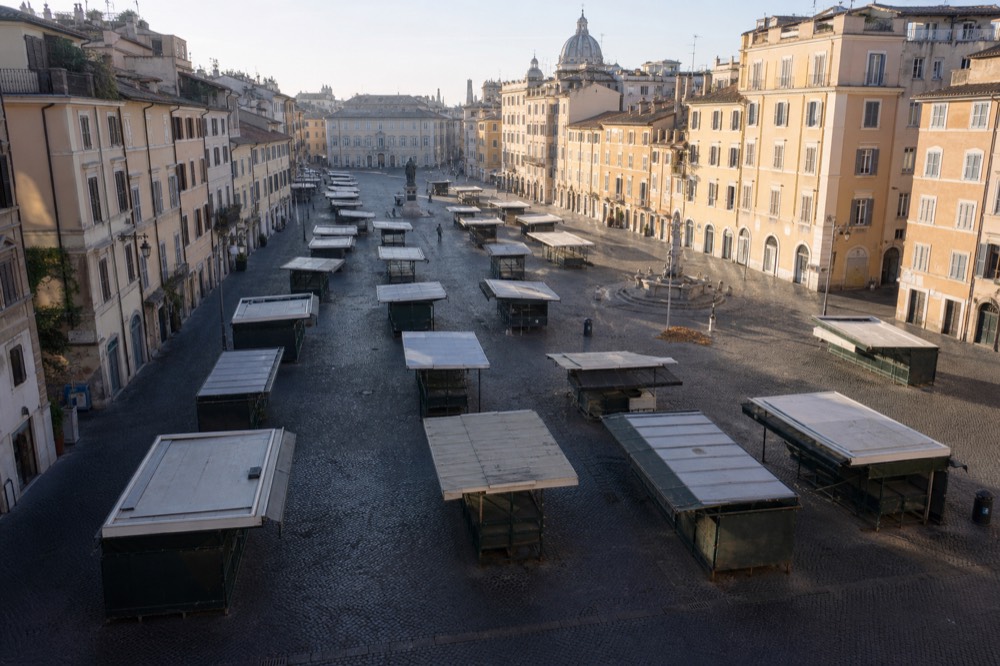
The market layer runs on a different clock from the dinner layer, and mixing them up is the classic first-timer's error. Testaccio's market shuts at 15:30, Monday to Saturday. Mercato Centrale at Termini is the exception that proves the flexibility: a food hall, not a produce market, open every day 07:30 to 23:30, with no booking involved at any counter. Trionfale's official page shows a split worth knowing: the produce stalls close at 14:00 most days and 19:00 on Friday, but the eating stalls inside run to 23:00 Tuesday to Saturday, and the whole complex closes Sunday. A dinner built on a market needs the evening half of that split, not the morning one.
One more mechanic belongs in the timing section because it is money, not clocks. Rome, unlike Florence, prohibits the coperto: article 16 comma 3 of Lazio regional law 21/2006 bans additional cover charges outright, and the lawful alternative is a servizio component, permitted only where the price list shows it and is available before you order. Some Roman restaurants charge a coperto regardless, which is documented, and the price list in your hands before ordering is your actual protection. That is the whole printable fact, and it is more useful than any folklore version of it.
The budget question that sits underneath all of this, including what an espresso at the counter actually costs and how the al banco versus al tavolo pricing works, is covered in the eating in Rome on a budget guide. The short version for this page: counter prices in Rome remain among the lower big-city figures in Italy, the nasoni drinking fountains number over 3,000 across the city with more than 200 in the historic centre, and a walking evening built on counters, stalls and gelato is the cheapest good meal in the city.
The questions below are the ones that actually come up around Tucci's Rome picks, and the answers stick to what the restaurants themselves publish rather than the recycled listicle version of it. Each answer states a mechanic, a price or a closure from the venue's own published policy, never a celebrity claim without a source. Read them as the compressed version of everything above.
Common Questions About Tucci's Rome Picks
Where Does Stanley Tucci Recommend To Eat In Rome?
The documented on-camera record is much narrower than the listicles suggest, and most of the names attributed to him on the web carry no citation to any episode, clip or interview. Treat every unsourced "Tucci pick" as listicle recycling, and build your plan from the booking mechanics of the famous rooms instead, which this page states from the restaurants' own policies.
Can You Get Into The Trattorie The Celebrity Rome Lists Name?
Sometimes, but rarely the way a listicle implies. Da Enzo al 29 takes no reservations in any service and runs a line out the door; Armando al Pantheon's book runs thirty days out and a new day releases online at midnight; Roscioli books online only against a credit card guarantee; Tonnarello takes no bookings at any of its five addresses. The mechanism, not the name, decides your evening.
Is A Food Tour A Good Substitute For The Famous Tables?
A tour is a different product, not a substitute, and no tour on this roster enters the famous restaurants. What it does is remove the reservation problem and cover several counters in one booked, fixed-price outing with a published meeting point. The 20-plus tastings walk in Trastevere runs about four hours, includes dinner and free-flowing wine, and starts from $120.78 per person (checked September 2026) with free cancellation.
Does Rome Close In August?
No. Il Messaggero, reporting the trade associations, puts the scale at about 40 per cent of shops and restaurants closing for two weeks or more, with the majority taking roughly four days around 15 August. Five famous kitchens publish their own 2026 shutdown dates, and Roscioli stays open all month except the 15th. Build from per-venue dates, not the myth.
Which Parts Of Rome Eating Need No Booking At All?
The gelaterie, the coffee counters, the bakeries, the market stalls, the wine bars and the big evening pizzerias: twenty-nine of the sixty best-known Roman tables and counters score one or two on the friction scale, meaning you walk in. Sant'Eustachio Il Caffè is open every day of the year except two, and Trapizzino Testaccio serves from noon to 23:00 daily with no booking method at all.